Thursday, July 05, 2007
Will the Leafs Utilize Toskala Correctly?
by Jes
The Maple Leafs made a big gamble on the mentally insecure Andrew Raycroft, and it totally, and unsurprisingly, blew up in their faces.
To rectify the situation, the Leafs went and dealt for long-time backup Vesa Toskala, and instantly upgraded a weakness on their club.
Now, the Leafs have a goalie used to playing a heavy load, and one goalie that wants to play a heavier load.
Raycroft ($2,000,000): 72GP 2.99GAA 89.4SV% (87.9SV% the season before that)
Toskala ($1,375,000): 38GP 2.35GAA 90.8SV% (90.1SV% the season before that)
The Leafs are talking about a "2-goalie system", but there is no reason that Toskala shouldn't be given the de-facto #1 job based on talent alone. Raycroft has been a poor goalie for 2 years, and giving him ~50% of the starts is just going to make it harder to the Leafs to win games.
A 2-goalie system only works when you have 2 average+ goaltenders, which the Leafs don't have. The Wild had Fernandez, Roloson, and Backstrom putting up good SV% year after year. The Wild could put any of their goalies in the net, and be assured of good goaltending. Most teams don't use a similar system because they don't have TWO average+ goaltenders.
While Toskala may be average at best, that is a serious upgrade from where the Leafs were before the trade, and it was good of the Leafs to do SOMETHING in this regard.
Now, if Vesa doesn't get at least 55 of the Leafs 82 starts, then the Leafs simply negate most of the benefits of the deal. Just because the Leafs invested so much in Raycroft already, doesn't mean they should justify the cost by playing the guy more than they should.
The Maple Leafs made a big gamble on the mentally insecure Andrew Raycroft, and it totally, and unsurprisingly, blew up in their faces.
To rectify the situation, the Leafs went and dealt for long-time backup Vesa Toskala, and instantly upgraded a weakness on their club.
Now, the Leafs have a goalie used to playing a heavy load, and one goalie that wants to play a heavier load.
Raycroft ($2,000,000): 72GP 2.99GAA 89.4SV% (87.9SV% the season before that)
Toskala ($1,375,000): 38GP 2.35GAA 90.8SV% (90.1SV% the season before that)
The Leafs are talking about a "2-goalie system", but there is no reason that Toskala shouldn't be given the de-facto #1 job based on talent alone. Raycroft has been a poor goalie for 2 years, and giving him ~50% of the starts is just going to make it harder to the Leafs to win games.
A 2-goalie system only works when you have 2 average+ goaltenders, which the Leafs don't have. The Wild had Fernandez, Roloson, and Backstrom putting up good SV% year after year. The Wild could put any of their goalies in the net, and be assured of good goaltending. Most teams don't use a similar system because they don't have TWO average+ goaltenders.
While Toskala may be average at best, that is a serious upgrade from where the Leafs were before the trade, and it was good of the Leafs to do SOMETHING in this regard.
Now, if Vesa doesn't get at least 55 of the Leafs 82 starts, then the Leafs simply negate most of the benefits of the deal. Just because the Leafs invested so much in Raycroft already, doesn't mean they should justify the cost by playing the guy more than they should.
Labels: Analysis, Andrew Raycroft, Maple Leafs, Vesa Toskala


Tuesday, June 12, 2007
Analysis: The UFA Goaltending Market
by Jes
With the news that Nicklas Backstrom has re-signed with the Minnesota Wild, the market for good goaltending went from bad to worse.
So, What's left in the open market?
Using SV%, which is the best measure of a goaltenders' ability that we have easily available, we see that it's not much of a selection. Keep in mind that the average SV% for the league was 90.5% for ALL goaltenders.
Who needs goaltending? According to James Mirtle (where I got the idea for this post):
Looking at my list, there are only two above-average starting goaltenders available.
Thibault, Garon, and Aebischer could make average-at-best starters on a poor team. Sabourin may do well if he got a real shot. Otherwise? It's all backups, and some very poor ones at that. Oh, batty Belfour and his bad back are there, if anyone really wants him.
I'm very glad that the Canucks have Luongo locked up nicely. They simply need to bring in a backup that can play half decent in a handful of games. I'd like to see Sabourin back for another season, but I'd understand if he wants to go somewhere that would give him a true chance to shine.
Giguere? This is his big chance to cash in, seeing as how he is, by far, the biggest fish in the UFA goalie pond. Toronto would be wise to open up the pocket book, if possible, and realize that the Andrew Raycroft experiment was a gigantic failure.
While Hasek can still kick it old school, you know he's too flakey for some teams and very picky about where he wants to go.
Is it any wonder why Manny Fernandez might now be a really great trading chip for the Minnesota Wild?
With the news that Nicklas Backstrom has re-signed with the Minnesota Wild, the market for good goaltending went from bad to worse.
So, What's left in the open market?
Using SV%, which is the best measure of a goaltenders' ability that we have easily available, we see that it's not much of a selection. Keep in mind that the average SV% for the league was 90.5% for ALL goaltenders.
PLAYER        Save Percentage%
--------------------------------
J-S Giguere        91.8%
D. Hasek           91.2%
J. Thibault        90.9%
Mathieu Garon      90.7%
D. Sabourin        90.6%
Ed Belfour         90.2%
D. Aebischer       90.0%
J. McLennan        89.5%
Curtis Joseph      89.3%
J. Markkanen       88.6%
B. Boucher         88.2%
Kevin Weekes       87.9%
Robert Esche       87.2%
--------------------------------
Who needs goaltending? According to James Mirtle (where I got the idea for this post):
In terms of starters, Boston, Columbus, Detroit, Florida, Los Angeles, Phoenix and Toronto could all potentially be in the market. (Not surprisingly, only one of those teams made the postseason last year.)
There are a great deal more teams searching for backups, including some teams like Vancouver where the second netminder will have to pick up janitorial duties on the side to earn his minimum salary.
Looking at my list, there are only two above-average starting goaltenders available.
Thibault, Garon, and Aebischer could make average-at-best starters on a poor team. Sabourin may do well if he got a real shot. Otherwise? It's all backups, and some very poor ones at that. Oh, batty Belfour and his bad back are there, if anyone really wants him.
I'm very glad that the Canucks have Luongo locked up nicely. They simply need to bring in a backup that can play half decent in a handful of games. I'd like to see Sabourin back for another season, but I'd understand if he wants to go somewhere that would give him a true chance to shine.
Giguere? This is his big chance to cash in, seeing as how he is, by far, the biggest fish in the UFA goalie pond. Toronto would be wise to open up the pocket book, if possible, and realize that the Andrew Raycroft experiment was a gigantic failure.
While Hasek can still kick it old school, you know he's too flakey for some teams and very picky about where he wants to go.
Is it any wonder why Manny Fernandez might now be a really great trading chip for the Minnesota Wild?
Labels: Analysis, J-S Giguere, UFA
Wednesday, March 28, 2007
A Brief Look at Post-Lockout NHL Attendance
by Jes
I was looking at the NHL attendance figures provided on ESPN.com, as I periodically do, just to see any possible trends and items of note.
Here are the figures from 2005/06 compared to this season's numbers.

The overall average went down, but I wouldn't put any stock into that number. We know that some teams were padding (and still are) their attendance numbers with freebies and big discounts.
The 'worst' Canadian team for attendance is the Edmonton Oilers, with an average of 16,839 which fills 98.5% of their stated capacity. Yes, even the worst Canadian teams fill the building on a regular basis.
The one crappy team doing great at the gate is the Philadelphia Flyers, who suckered a lot of their fans into renewing season tickets, despite a big price increase, by banking on the fact that their veteran-laden team would be competitive. Did anyone expect the Flyers to tank out quite this bad? It'll be interesting to see if they experience a huge drop-off next season.
The Nashville Predators have made some modest gains at the gate, but one of the best teams in the NHL is still struggling as they rank 23rd in attendance.
It's amazing just how quickly the Blues fans jumped off of the ship. To their credit, the ticket prices are high and the product quality has been low. Still, with a good new coach in Andy Murray, I would hope to see better support next year. The Blues have been pretty competitive since the coaching change.
It looks like Caps fans aren't buying into the Ovechkin+filler product, as their attendance still wallows near the basement. I wouldn't advocate ever moving the Crapitals, but their fan support has got to improve eventually. The Caps have had a hard time being a strong market at the best of times, and now they've got one of the more bankable stars in the game.
Carolina made a nice leap after the Stanley Cup win, with an increase in ~2,000 per game. If they miss the playoffs, will they dip right back down? It's likely.
Now that Colorado is surely out of the playoffs (Greg, you know it's true), just watch their attendance dip about 1,000 per game next season. These fans have been spoiled for a decade, and now we'll see their true colours.
Phoenix - You want to talk about inflated figures? There is no way in Hades that Phoenix draws 14,000 actual human beings to most of their games. From my brief experience, I know quite a few rich peeps down there are inclined to buy seasons tickets and not go to the games all too often. Hockey isn't working in Phoenix for a variety of reasons, but don't expect the NHL to move this franchise any day soon.
Chicago - How low can they go? How long will the NHL allow Dollar Bill Wirtz to continue killing this franchise before they step in?
I was looking at the NHL attendance figures provided on ESPN.com, as I periodically do, just to see any possible trends and items of note.
Here are the figures from 2005/06 compared to this season's numbers.

Labels: Analysis, attendance, NHL
Thursday, March 15, 2007
When Bad Goalies Go Good! O_o
by Jes
The Forechecker, one of the web's best hockey bloggers for stats analysis, looks at how goalies are faring in shootouts in his latest FoxSports column.
Who's at the top? That might surprise you...
I added in their regular SV% and rank, and you can see that Rick DiPietro is the only Top 10 goalie that really rocks in the shootout. The rest of the group is a mish-mash of mediocre goalies, with Marc Denis, one of the worst, as the king of the shootout.
Fortunately, the playoffs will eliminate this joke of a skills competition, so guys like Miikka Kiprusoff and Roberto Luongo won't have to worry about their poor shootout records when the games mean more. These stats are strange, and basically just tell you that regular goaltending ability doesn't seem to correlate well with shootout ability.
The Forechecker, one of the web's best hockey bloggers for stats analysis, looks at how goalies are faring in shootouts in his latest FoxSports column.
Last week I dug into the offensive end of NHL shootouts, so now we need to give the goaltenders their due.While a player may just totally blow a shot, the goaltenders need to get more credit for forcing a miss.
As we consider goaltender success during the shootout, a significant aspect to contend with is the quantity of Missed Shots (roughly one out of eight shootout attempts misses the net entirely). Within the table below, I'm including them in a "Stop Pct.", since by definition, Missed Shots aren't included in a goaltender's regular save percentage.
When it comes to the shootout, however, I'm inclined to give the netminder some credit for forcing the shooter into an untenable option. So let's get to the results, including the 2005-06 season, and this year up through the games of Feb. 4:
Who's at the top? That might surprise you...
Goaltender        Attempts Goals Saves Missed Stop Pct. Normal SV%
Marc Denis, TBL        32    5     24   3      .844     .887 (42nd)
Kari Lehtonen, ATL     39    7     28   4      .821     .911 (13th)
Henrik Lundqvist, NYR  63    12    40   11     .810     .912 (12th)
Rick DiPietro, NYI     67    16    48   3      .761     .918 (7th)
Tim Thomas, BOS        54    13    39   2      .759     .910 (17th)
Pascal LeClaire, CBJ   33    8     20   5      .758     .897 (34th)
Manny Fernandez, MIN   51    13    29   9      .745     .911 (14th)
Ryan Miller, BUF       43    11    25   7      .744     .910 (15th)
Marty Turco, DAL       55    15    29   11     .727     .909 (18th)
Mathieu Garon, LAK     29    8     19   2      .724     .905 (25th)
I added in their regular SV% and rank, and you can see that Rick DiPietro is the only Top 10 goalie that really rocks in the shootout. The rest of the group is a mish-mash of mediocre goalies, with Marc Denis, one of the worst, as the king of the shootout.
Fortunately, the playoffs will eliminate this joke of a skills competition, so guys like Miikka Kiprusoff and Roberto Luongo won't have to worry about their poor shootout records when the games mean more. These stats are strange, and basically just tell you that regular goaltending ability doesn't seem to correlate well with shootout ability.
Labels: Analysis, goaltenders, shootouts, The Forechecker
Thursday, February 15, 2007
A look-see at the NHL's Goaltenders
Now that we're 2/3rd done the season, I feel the need to analyze some of the goaltenders in the league as we head into the stretch run.
Martin Brodeur - (55GP 35-15-5, 2.07GAA, 92.7%)
I've been oft-critical of Martin Brodeur, the goaltender with the golden horseshoe up his arse. While he has always piled up the big win totals and made the most out of great situations, he's rarely ever been among the true top 3 in the league in any one season. He's got a nice Vezina replica on his trophy shelf, but it wasn't really deserved.
This season? He's actually got an amazing case for the Vezina, and has truly never played better. He's second in the league with a 92.7SV%, first in shutouts with 10(!), first in wins (35), and first in GAA with 2.07.
He's faced 27.89 shots per 60 minutes, which is a much higher rate than what's he has been used to in past years, and has kept the Devils on a successful path despite many roster deletions over the past couple of seasons.
I'll give him his props, he definitely is Vezina-worthy this season.
Roberto Luongo - (54GP 32-18-3, 2.34GAA, 92.1SV%)
At the start of the season, Luongo was really struggling and was definitely not the "Luongod" we expected. Fortunately, the fans here were willing to cut him some slack (very rare for any goaltender) and supported Luongo through his adjustment period. I guess the fans (as I did) figured Luongo would find himself eventually, and he certainly did.
I don't often pump goalies for the MVP, but Luongo has a great case based on the "Most valuable to his team" argument. No goalie has faced more shots on goal this year (1553, 29.60 per 60 minutes), and no goalie has had quite the profound effect on his team, not even Brodeur. Want to know where the Canucks would be with Dan Cloutier back in net? Sniffing the Blue Jackets' asses like a dog.
---
Sometimes, the best laid plans go to waste, and a backup goalie ends up supplanting the "#1" and doing a much better job.
OTTAWA
Ray Emery: 41GP 24-13-2, 2.40GAA, 92.3SV%
Martin Gerber: 21GP 9-9-1, 2.92GAA, 90.4SV%
...and this isn't the first time Gerber has been usurped. You'd think Ottawa would have looked at Gerber's real numbers from last year before shelling out millions....
COLORADO
Peter Budaj: 35GP 17-13-3, 2.67GAA, 90.9SV%
Jose Theodore: 27GP 10-12-1, 3.30GAA, 89.2SV%
As a Canucks fan, I'm quite happy that the Colorado Avalanche were dumb enough to dress the shell-shocked Theodore so often to justify his large salary. If the Avs played Budaj more than they have, they'd likely be in a playoff spot.
---
The best true tandem? That would be the Nashville Predators. When Tomas Vokoun went down with a long-term injury earlier this season, there was much panic in the land that produces really bad "country" music.
Instead, Chris Mason came in and did an ever better job than Vokoun. Given Mason's numbers from last season, it's not a huge surprise...
Chris Mason: 33GP, 21-9-2, 2.35GAA, 92.7SV%
Tomas Vokoun: 27GP, 18-7-1, 2.38GAA, 92.1SV%
---
Who has the easiest goaltending job in the NHL? That would be Dominik "Smoker's Teeth" Hasek, who faces a measly 22.53 shots per 60 minutes. He has the very shiny wins (30), GAA (2.08), and gets a load of positive press. What the press doesn't seem to notice is his league-average 90.8SV%.
Still, the Wings are doing the smart thing by keeping Hasek from getting fatigued and tearing up his groin during the season. All the Wings need is for Hasek to 'be there' when the playoffs start.
---
Sometimes, a good offence isn't enough...
Q: What do the Carolina Hurricanes, Atlanta Thrashers, and Tampa Bay Lightning all have in common?
A: Great goal scoring and crappy goaltending! All 3 teams have littered the scoring leaderboards with offensive firepower (Whitney, St. Louis, Lecavalier, Hossa, Kovalchuk, etc...), and are struggling to achieve a great deal of success.
The Hurricanes rank 8th in goals for and 22nd in goals against.
The Lightning rank 10th in goals for 20th in goals against
The Thrashees rank 11th in goals for and 25th in goals against.
Somehow, the Tampa Bay Lightning thought that bringing in a guy who could barely handle the #1 duties for the Columbus Blue Jackets would be the solution to their goaltending problems. Huh??!?! Well, he didn't work out so well, so they got some generic Swedish guy to take over...
Marc Denis: 30GP 11-13-2, 3.15GAA, 88.0SV% (2nd worst)
Johan Holmqvist: 33GP 21-11-10, 2.64GAA, 90.1SV% (Winning despite a poor SV%)
The Carolina Hurricanes were smart to let the Sens overpay for Martin Gerber, but fooled into thinking Cam Ward could handle the #1 duties.
While his cup ring will earn Ward a LOT of leeway, it was always hard for me to ignore his really bad regular season numbers last year. He got hot at the right time, and it was hard to project if he could hold his playoff performance into the regular season.
Cam Ward: 46GP 24-14-6, 2.88GAA, 89.9SV%
The Thrashees? Well, Kari Lehtonen's final fantasy is giving out just-below-average goaltending with a statline of 51GP 25-17-8, 2.88GAA, 90.8SV%.
Unlike Hasek, who can sleep through half of his games, Kari faces a whopping 31.51 shots per game! Kari isn't carrying the team, but you can't blame him for the Thrashers inattention to defence.
Martin Brodeur - (55GP 35-15-5, 2.07GAA, 92.7%)
I've been oft-critical of Martin Brodeur, the goaltender with the golden horseshoe up his arse. While he has always piled up the big win totals and made the most out of great situations, he's rarely ever been among the true top 3 in the league in any one season. He's got a nice Vezina replica on his trophy shelf, but it wasn't really deserved.
This season? He's actually got an amazing case for the Vezina, and has truly never played better. He's second in the league with a 92.7SV%, first in shutouts with 10(!), first in wins (35), and first in GAA with 2.07.
He's faced 27.89 shots per 60 minutes, which is a much higher rate than what's he has been used to in past years, and has kept the Devils on a successful path despite many roster deletions over the past couple of seasons.
I'll give him his props, he definitely is Vezina-worthy this season.
Roberto Luongo - (54GP 32-18-3, 2.34GAA, 92.1SV%)
At the start of the season, Luongo was really struggling and was definitely not the "Luongod" we expected. Fortunately, the fans here were willing to cut him some slack (very rare for any goaltender) and supported Luongo through his adjustment period. I guess the fans (as I did) figured Luongo would find himself eventually, and he certainly did.
I don't often pump goalies for the MVP, but Luongo has a great case based on the "Most valuable to his team" argument. No goalie has faced more shots on goal this year (1553, 29.60 per 60 minutes), and no goalie has had quite the profound effect on his team, not even Brodeur. Want to know where the Canucks would be with Dan Cloutier back in net? Sniffing the Blue Jackets' asses like a dog.
---
Sometimes, the best laid plans go to waste, and a backup goalie ends up supplanting the "#1" and doing a much better job.
OTTAWA
Ray Emery: 41GP 24-13-2, 2.40GAA, 92.3SV%
Martin Gerber: 21GP 9-9-1, 2.92GAA, 90.4SV%
...and this isn't the first time Gerber has been usurped. You'd think Ottawa would have looked at Gerber's real numbers from last year before shelling out millions....
COLORADO
Peter Budaj: 35GP 17-13-3, 2.67GAA, 90.9SV%
Jose Theodore: 27GP 10-12-1, 3.30GAA, 89.2SV%
As a Canucks fan, I'm quite happy that the Colorado Avalanche were dumb enough to dress the shell-shocked Theodore so often to justify his large salary. If the Avs played Budaj more than they have, they'd likely be in a playoff spot.
---
The best true tandem? That would be the Nashville Predators. When Tomas Vokoun went down with a long-term injury earlier this season, there was much panic in the land that produces really bad "country" music.
Instead, Chris Mason came in and did an ever better job than Vokoun. Given Mason's numbers from last season, it's not a huge surprise...
Chris Mason: 33GP, 21-9-2, 2.35GAA, 92.7SV%
Tomas Vokoun: 27GP, 18-7-1, 2.38GAA, 92.1SV%
---
Who has the easiest goaltending job in the NHL? That would be Dominik "Smoker's Teeth" Hasek, who faces a measly 22.53 shots per 60 minutes. He has the very shiny wins (30), GAA (2.08), and gets a load of positive press. What the press doesn't seem to notice is his league-average 90.8SV%.
Still, the Wings are doing the smart thing by keeping Hasek from getting fatigued and tearing up his groin during the season. All the Wings need is for Hasek to 'be there' when the playoffs start.
---
Sometimes, a good offence isn't enough...
Q: What do the Carolina Hurricanes, Atlanta Thrashers, and Tampa Bay Lightning all have in common?
A: Great goal scoring and crappy goaltending! All 3 teams have littered the scoring leaderboards with offensive firepower (Whitney, St. Louis, Lecavalier, Hossa, Kovalchuk, etc...), and are struggling to achieve a great deal of success.
The Hurricanes rank 8th in goals for and 22nd in goals against.
The Lightning rank 10th in goals for 20th in goals against
The Thrashees rank 11th in goals for and 25th in goals against.
Somehow, the Tampa Bay Lightning thought that bringing in a guy who could barely handle the #1 duties for the Columbus Blue Jackets would be the solution to their goaltending problems. Huh??!?! Well, he didn't work out so well, so they got some generic Swedish guy to take over...
Marc Denis: 30GP 11-13-2, 3.15GAA, 88.0SV% (2nd worst)
Johan Holmqvist: 33GP 21-11-10, 2.64GAA, 90.1SV% (Winning despite a poor SV%)
The Carolina Hurricanes were smart to let the Sens overpay for Martin Gerber, but fooled into thinking Cam Ward could handle the #1 duties.
While his cup ring will earn Ward a LOT of leeway, it was always hard for me to ignore his really bad regular season numbers last year. He got hot at the right time, and it was hard to project if he could hold his playoff performance into the regular season.
Cam Ward: 46GP 24-14-6, 2.88GAA, 89.9SV%
The Thrashees? Well, Kari Lehtonen's final fantasy is giving out just-below-average goaltending with a statline of 51GP 25-17-8, 2.88GAA, 90.8SV%.
Unlike Hasek, who can sleep through half of his games, Kari faces a whopping 31.51 shots per game! Kari isn't carrying the team, but you can't blame him for the Thrashers inattention to defence.
Labels: Analysis, brodeur, cam ward, emery, goaltenders, hasek, Lehtonen, luongo, marc denis, opinion, statistics
Monday, January 15, 2007
Random Bric-a-Brac
A random grab-bag of assorted stuff...
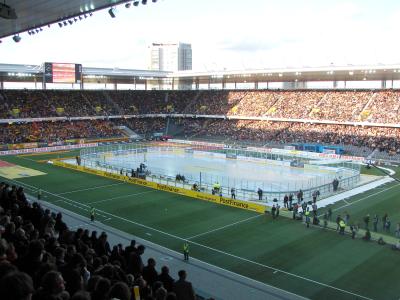
1. Joeri @ Eurohockey sent me a link to a story about SC Bern and SCL Tigers playing a hockey game in a soccer stadium.
They broke a European record with an attendance of 30,076 fans, who watched Bern beat the Tigers by a 5-2 score. There were some ex-NHLers in the game, with Christian Dube getting 3 assists, and Christian Berglund and Simon Gamache each notching 2 points.
2. To say that Marc Chouinard has been a tremendous bust for the Vancouver Canucks is to understate the obvious. He's below 50% on face-offs, which is supposed to be his best attribute. He's slow, clumsy, ineffective offensively, and has a rather poor work ethic for a 'role player'.
If you ever needed proof of Jacques Lemaire's coaching ability, just look at Chouinard's career stats.
Somehow, Lemaire coaxed two pretty useful seasons out of Chouinard. The rest of Marc's career has been atrocious.
3. Marek Malik's amazing shootout goal last season was beautiful, but it wasn't the first time that such a goal had ever been scored.
His inspiration? Robert Kysela, a well-known Czech Extraliga veteran who pulled this move out of his hat in 2001.
This wasn't some meaningless post-game shootout for a bonus point, either. No, this was a playoff game (First Round match-up) pitting Litvinov against evil Sparta Praha. Kysela had a regulation time penalty shot against Petr Briza and made a name for himself with one of the more amazing goals in league history.
1. Joeri @ Eurohockey sent me a link to a story about SC Bern and SCL Tigers playing a hockey game in a soccer stadium.
They broke a European record with an attendance of 30,076 fans, who watched Bern beat the Tigers by a 5-2 score. There were some ex-NHLers in the game, with Christian Dube getting 3 assists, and Christian Berglund and Simon Gamache each notching 2 points.
2. To say that Marc Chouinard has been a tremendous bust for the Vancouver Canucks is to understate the obvious. He's below 50% on face-offs, which is supposed to be his best attribute. He's slow, clumsy, ineffective offensively, and has a rather poor work ethic for a 'role player'.
If you ever needed proof of Jacques Lemaire's coaching ability, just look at Chouinard's career stats.
Year Team GP G  A Pts +/- PIM
00-01 ANH 44 3  4  7  -5   12
01-02 ANH 45 4  5  9   2   10
02-03 ANH 70 3  4  7  -9   40
03-04 MIN 45 11 10 21  4   17
05-06 MIN 74 14 16 30  1   34
06-07 VAN 31 1  2  3  -2   6
Career   309 36 41 77 -9   119
Somehow, Lemaire coaxed two pretty useful seasons out of Chouinard. The rest of Marc's career has been atrocious.
3. Marek Malik's amazing shootout goal last season was beautiful, but it wasn't the first time that such a goal had ever been scored.
His inspiration? Robert Kysela, a well-known Czech Extraliga veteran who pulled this move out of his hat in 2001.
This wasn't some meaningless post-game shootout for a bonus point, either. No, this was a playoff game (First Round match-up) pitting Litvinov against evil Sparta Praha. Kysela had a regulation time penalty shot against Petr Briza and made a name for himself with one of the more amazing goals in league history.
Labels: Analysis, Kysela, Malik, Marc Chouinard, video
Friday, December 29, 2006
What's up with Daniel Cleary?
Apparently, his scoring.
For many years, Daniel Clearly always represented the height of 'laziness' to me. He never seem to 'bring it' very often, and loafed around so much that even Todd Bertuzzi would be shaking his head in disbelief. For all of his promise, Cleary was clearly a 'useless' player for much of his career.
All of a sudden, Cleary started scoring more, playing harder, and turned into a useful player. This wouldn't be the first time that the Detroit Red Wings have turned trash into treasure. It just goes to show what good coaching and development can do for a club. *grumble*
Just check out the career stats...
Yeah, one of these things is not like the other...
Then, I happened upon this article by Pierre LeBrun. It seems Cleary has finally whipped his ass into gear and taken his work ethic to a different level.
It just goes to show that leopards can sometimes change their spots. It'll be interesting to see if Cleary can maintain this new-found production.
For many years, Daniel Clearly always represented the height of 'laziness' to me. He never seem to 'bring it' very often, and loafed around so much that even Todd Bertuzzi would be shaking his head in disbelief. For all of his promise, Cleary was clearly a 'useless' player for much of his career.
All of a sudden, Cleary started scoring more, playing harder, and turned into a useful player. This wouldn't be the first time that the Detroit Red Wings have turned trash into treasure. It just goes to show what good coaching and development can do for a club. *grumble*
Just check out the career stats...
Year Team GP G  A Pts +/- PIM
97-98 CHI  6 0  0  0  -2   0
98-99 CHI 35 4  5  9  -1  24
99-00 EDM 17 3  2  5  -1   8
00-01 EDM 81 14 21 35  5  37
01-02 EDM 65 10 19 29 -1  51
02-03 EDM 57 4  13 17  5  31
03-04 PHO 68 6  11 17 -8  42
05-06 DET 77 3  12 15  5  40
06-07 DET 37 17 11 28  12  8
Career   443 61 94 155 14 241
Yeah, one of these things is not like the other...
Then, I happened upon this article by Pierre LeBrun. It seems Cleary has finally whipped his ass into gear and taken his work ethic to a different level.
Look no further than Hockeytown for one of the coolest stories in the NHL this season.Now, if only JAN BULIS could start emulating Cleary and turn himself into a useful scorer, the Canucks might make the playoffs.
Daniel Cleary has a career-high 17 goals and it's not even January yet. "If feels good," the Detroit Red Wings forward said over the phone Friday. That might sound like a cliche from almost any other player but it speaks volumes coming from Cleary. After a decade full of trials and tribulations, it appears he's finally showing the form that was expected of him long ago.
"I've matured as a person and as a player, that's the first thing," said the 28-year-old native of Carbonear, Nfld. "I've dedicated myself to hockey. I've become a lot more determined.
"The last few years, I've really started concentrating on making this a 12-month job and training hard in the off-season and preparing myself."
It just goes to show that leopards can sometimes change their spots. It'll be interesting to see if Cleary can maintain this new-found production.
Labels: Analysis, Cleary, Red Wings
Wednesday, December 27, 2006
Mats Sundin: The King of Consistency?
by Gőlbez
Consistent - (kən-sĭs'tənt) adjective:
Reliable; steady: "demonstrated a consistent ability to impress the critics."
One of the most overused words in sports
What does it mean to be consistent? If you listen to hockey people, it's a lack of effort or a bad game. ("We didn't put forth a consistent effort!")
However, if you can consistently awful, then you aren't 'inconsistent', are ya?
A great team can also be wildly inconsistent. Let's say the Vancouver Canucks win 5, lose 2, win 1, lose 2, win 7, lose 3, win 1, lose 1, win 5, lose 3, win 1, lose 4, win 10. Yes, they are quite inconsistent, but they are still doing great and would finish 30-15. Meanwhile, a team that loses every single game is totally consistent.
Anyway, I was perusing Mats Sundin's career stats (Why? I don't remember) and was just amazed at how consistent his production has been over almost his entire career.
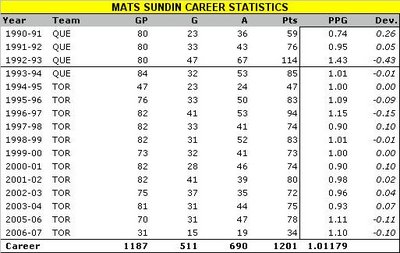
After his initial 3-year introduction phase, Mats settled down and has put out pretty much a consistent point-a-game pace since 1993-94! He only deviates more than .10 points-per-game in two different seasons, even if his goals and assists totals fluctuate quite a bit. Even in his late 30's, he's still putting up the same pace.
It's also interesting that Mats has missed very little time due to injury. Apart from this season, Mats doesn't really miss any long periods of time due to injury (That 48 game season was the shortened season).
Mats gets a lot of flak from Leafs lemmings for not being able to lead the Leafs to the Stanley Cup, as if it is his responsbility to coach and manage the team as well.
Sundin may be the real live version of a Swedish troll, but let's give credit where it is due. Mats Sundin has to be one of the most bankable and consistent players in NHL history. A player who misses little time due to injury and puts up a point a game while playing good defensively? There's a lot of value in having that kind of certainty, and it would be nice if the media made more of a point about that.
Forget the 'promise' that so many other players offer (Alexei Kovalev, anyone?) and give me the player that keeps performing at a consistent level.
Here's to Mats Sundin, the true NHL's truly "Consistent" player.
Consistent - (kən-sĭs'tənt) adjective:
What does it mean to be consistent? If you listen to hockey people, it's a lack of effort or a bad game. ("We didn't put forth a consistent effort!")
However, if you can consistently awful, then you aren't 'inconsistent', are ya?
A great team can also be wildly inconsistent. Let's say the Vancouver Canucks win 5, lose 2, win 1, lose 2, win 7, lose 3, win 1, lose 1, win 5, lose 3, win 1, lose 4, win 10. Yes, they are quite inconsistent, but they are still doing great and would finish 30-15. Meanwhile, a team that loses every single game is totally consistent.
Anyway, I was perusing Mats Sundin's career stats (Why? I don't remember) and was just amazed at how consistent his production has been over almost his entire career.
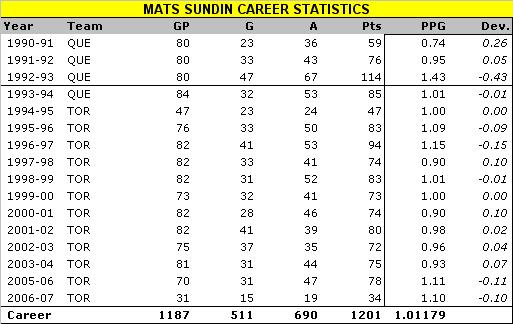
After his initial 3-year introduction phase, Mats settled down and has put out pretty much a consistent point-a-game pace since 1993-94! He only deviates more than .10 points-per-game in two different seasons, even if his goals and assists totals fluctuate quite a bit. Even in his late 30's, he's still putting up the same pace.
It's also interesting that Mats has missed very little time due to injury. Apart from this season, Mats doesn't really miss any long periods of time due to injury (That 48 game season was the shortened season).
Mats gets a lot of flak from Leafs lemmings for not being able to lead the Leafs to the Stanley Cup, as if it is his responsbility to coach and manage the team as well.
Sundin may be the real live version of a Swedish troll, but let's give credit where it is due. Mats Sundin has to be one of the most bankable and consistent players in NHL history. A player who misses little time due to injury and puts up a point a game while playing good defensively? There's a lot of value in having that kind of certainty, and it would be nice if the media made more of a point about that.
Forget the 'promise' that so many other players offer (Alexei Kovalev, anyone?) and give me the player that keeps performing at a consistent level.
Here's to Mats Sundin, the true NHL's truly "Consistent" player.
Labels: Analysis, Maple Leafs, Sundin
Thursday, December 07, 2006
Joe Nieuwendyk Retires. Is the HoF Next?
After being limited to 15 games this season, 40-year old Joe Nieuwendyk has decided to retire due to his constant back pain.
Joe has always been of an odd-ball, given that he's one of the few players who scored more goals in their rookie season than any other year of their careers. Joe had 51 back as rookie in 87-88 and again as a sophomore in 88-89. Strangely enough, he never hit that total again and his goal total decreased as time went on. Players don't usually take a purely downhill trend in their goal totals, especially ones who play over 1000 games.
Joe was also an atypical centerman, as he was not the pass-first, shoot-second type of centerman that we're accustomed to. Joe finished with exactly 564 goals and 562 assists, and had more goals than assists for pretty much his entire career. Joe played the offensive game a lot more like a winger than a centerman, yet managed to play great defence as a centerman is often expected to.
From TSN.ca:
Hall of Fame?
Well, it certainly merits CONSIDERATION, but does it merit a plaque on the same wall as Peter Stastny?
Given the HoF's strange selections in the past, it's hard to predict who exactly makes the 'criteria', but we'll do our best...
POINTS FOR:
The counting stats: 1118 points in the regular season (almost a point-a-game pace) and 116 in the playoffs. He'll finish in the Top 50 for regular season scoring and that is a big plus
The cups: We know how heavily the voters count cups, especially the fact that Joe won 3 with 3 different clubs. Joe was a big part of those wins, and didn't just happen to luck out as much as a guy like Mike Commodore.
Conn Smythe: Proof that Joe was a BIG player in the playoffs and very instrumental in a cup win.
Olympic Gold
Calder Trophy
Reputation: Joe has a very good reputation with the media as a typical "Canadian" player with a great attitude, leadership, and work ethic. Joe is also a King Clancy award winner and this will give him favour with the voters.
POINTS AGAINST:
Joe was never an elite player, despite what Gainey said. In fact, Joe was often the second best player on his own team (Calgary and MacInnis, Dallas and Modano, New Jersey and Stevens/Niedermayer).
4 All-Star games - Not that All-Star games are the greatest measurement, but Joe didn't play in a whole lot of them, and none after 1994.
Dino Ciccarelli, a player with more points and a better PPG pace is not in the Hall of Fame
Increased competition: There are many great players retiring in one big clump, which will make it harder to Joe to make the HoF, at least for awhile.
My choice would be that he's a Hall of Famer, given his counting stats, longevity, popularity and reputation in the media, and overall great 2-way play. He isn't the strongest Hall of Fame choice, but he certainly isn't nearly the weakest. He has a MUCH better case than Cam Neely
Greg Cartman @ The Puck Stops Hereagrees with the assessment:
Joe has always been of an odd-ball, given that he's one of the few players who scored more goals in their rookie season than any other year of their careers. Joe had 51 back as rookie in 87-88 and again as a sophomore in 88-89. Strangely enough, he never hit that total again and his goal total decreased as time went on. Players don't usually take a purely downhill trend in their goal totals, especially ones who play over 1000 games.
Joe was also an atypical centerman, as he was not the pass-first, shoot-second type of centerman that we're accustomed to. Joe finished with exactly 564 goals and 562 assists, and had more goals than assists for pretty much his entire career. Joe played the offensive game a lot more like a winger than a centerman, yet managed to play great defence as a centerman is often expected to.
From TSN.ca:
Florida Panthers centre Joe Nieuwendyk has been forced to retire because of recurring back problems. Nieuwendyk announced his retirement Wednesday.
Nieuwendyk, 40, in his twentieth NHL season, scored eight points while playing just 15 of the team's first 29 games, because of injuries. The South Florida Sun-Sentinel reports that he visited a back specialist in Cleveland last Friday.
Nieuwendyk had 564 goals and 1126 points in 1257 career games and won Stanley Cups with three different franchises: Calgary (1989), Dallas (1999) and New Jersey (2003). He won the Conn Smythe Award as playoff MVP in 1999.
"I have the reached the stage where structurally my back isn't going to get any better. It's not the way I intended it, but I have to be realistic as well," Nieuwendyk said.
"He was an all-around elite player," said Montreal Canadiens general manager Bob Gainey, Nieuwendyk's coach and GM with the Dallas Stars. "He is the kind of player whose accomplishments merit consideration for the Hall of Fame."
Hall of Fame?
Well, it certainly merits CONSIDERATION, but does it merit a plaque on the same wall as Peter Stastny?
Given the HoF's strange selections in the past, it's hard to predict who exactly makes the 'criteria', but we'll do our best...
POINTS FOR:
POINTS AGAINST:
My choice would be that he's a Hall of Famer, given his counting stats, longevity, popularity and reputation in the media, and overall great 2-way play. He isn't the strongest Hall of Fame choice, but he certainly isn't nearly the weakest. He has a MUCH better case than Cam Neely
Greg Cartman @ The Puck Stops Hereagrees with the assessment:
He came back from the lockout as a valuable player even as a 39 year old. Despite missing 16 games to back problems, he is currently the third highest scorer on the Florida Panthers with 28 points in 36 games. He is still a valuable player to his team. Even after missing a season to lockout, Nieuwendyk has been a good scorer. Nieuwendyk is continuing to move up the all time goals list. He is currently the 23rd highest goal scorer of all time with 546 career goals. This season, he has passed Stan Mikita and Maurice Richard. Those are some elite players to have outscored. Had there been no lockout, Nieuwendyk would likely have moved another couple positions beyond that up the all time goal scoring list.
Labels: Analysis, Hall of Fame, Nieuwerndyk
Sunday, June 13, 2004
Objective Statistical Analysis - Breaking the 'Old School' Barriers
Out of all the major pro sports in North American, hockey is, by far, the most 'Old School' of sports when it comes to analysis.
When you talk about a player, scout a player, or compare two players, you generally see terms such as anticipation, hockey sense, balance, "Heart", "He comes up big in big games!" and so on. Rarely do you ever see a meaningful objective comparison or evaluation of players that isn't influenced by some sort of personal bias.
The problem? All of those traits are subjective, and cannot be objectively measured the same way by two different people. Where as I see Rob Niedermayer as a rather average skater due to his lack of first-step quickness and his apparent clumsiness, other scouts see a fast skater who can chew up ice like a sno-cone machine.
Hockey has very few resources for statistical analysis, an area which has always intrigued me. I have planned a few studies on my own, as I had seen nothing out there before. The famed book MONEYBALL: The Art of Winning an Unfair Game, showed how baseball's Oakland Athletics exploited market inefficiencies by using statistical analysis and 'non-traditional' analysis to sign players that other teams didn't value due to lacking 'The Good Face', or the 'Tools' (Speed, Power, etc), yet could perform well enough to justify a roster spot.
As Daryl Shilling put it, "Hockey lives in a completely different world than other businesses. Brokerage firms, for example, review the performances of funds and their workers scientifically, and make business decisions based on study. Hockey
bases almost every one of its decisions based purely on perception, which is
a an extremely limited method of evaluation."
Who is Daryl Shilling? Well, I was absolutely stunned and pleased to recently come across a site called The Hockey Project, where I found a very good counter-argument to my rant for Neely's HOF chances. This site is run by Daryl Shilling, and he has already developed some good studies that could really kickstart a 'Stathead' revolution in the hockey realm.
Basically, there are 2 major areas which present problems in performing objective statistical analysis, and then having said analysis accepted by the fans, media, and powers that be.
Lack of Deep, Meaningful, and Objective Data:
When you want to compare two players, say Martin St. Louis and Jerome Iginla , there isn't a lot of measures out there that can tell you a lot about the seasons they had, in context to the league around them.
From the basic stats readily available:
So, from the stats most commonly available to anyone, what can we see?
Well, St-Louis has more points, a better +/-, far less penalties, and most short-handed goals, while Iginia has more goals, more shots, and more game-winning goals.
So, can we truly conclude, from these basic stats, that St-Louis was a superior defensive player (+/- and SHG), while Iginla was more "clutch" because he scored more Game Winning Goals?
Well, most fans probably would and will conclude that from the statistics. There simply aren't details statistics available to measure defensive contribution, or other 'intangibles'.
A question? Do Short Handed Goals = great defensive play? or sacrificing defense for offense?
I ask this because, subjectively, Pavel Bure is the perfect example of racking up Short Handed Goals at the expense of defense.
Bure had 6 SHG in 97-98, and 34 in his career. From his time on the Canucks, I could say that he often 'poached' while killing penalties, looking for opportunities to score goals. For the opportunity to score shorthanded, Bure would give up attention to the defensive responsibilies that he was assigned. So, Short Handed Goals seem like a truly shaky argument for defensive ability, given the fact that the object of killing a penalty should be first and foremost to 'not get scored on'.
Unfortunately, the NHL does not keep much data that is 'deeper' than what I have provided you above. The only other statistic that I have not shown you is 'Time on Ice', where we can see that Iginla played 2:11 of shorthanded time per game compared to St-Louis' 1:36. This tells you that Iginla played more on the penalty-killing units, but it doesn't tell you who was better.
The NHL comes up 'Short Handed':
If you look at a typical hockey boxscore, you can't get very much from it (Who scored, assisted, shots, saves, penalties). Until recently, boxscores didn't even contain the player's individual +/- and Shots on Goal totals. So, if you look at a historical box score, you can't get very much at all from it other than the basic counting stats.
This is where the NHL comes in. As a custodian of the sport, the NHL has recenly gone backwards in the realm of record keeping. Just a few years ago, we were lucky enough to finally have access to statistics like hits, giveaways, takeaways, and blocked shots.
Unfortunately, the NHL stats keepers at most arenas, like NHL referees, were wildly inconsistant in their application of tabulating the numbers. Some arenas were extremely generous in giving out hits (New York), and some were extremely stingy.
When the NHLPA was brilliant enough to use stats to show the contributions of 'role' players, the NHL, in a move driven by simply pure greed, decided to stop providing these detailed stats to the public. Although the NHL was ordered to provide this information to the NHLPA, the NHL simply refuses to release these figures to the public.
So, in the end, we are left with only the basic statistics again, which makes it harder to develop meaningful measures and objective analysis.
Lack of Mainstream Acceptance:
I am sure some of you are reading this and thinking, "What a nerd, this guy has never played the game and he thinks you can know a player just by looking at some spreadsheets!"
This type of attitude is rampant among baseball scouts and executives, despite the inroads of statistical analysis into many front offices in that sport.
Why is it so hard for 'Old School' types, and mainstream media and fans to accept objective studies?
1. It's too 'hard' for them - People tend to fear and dislike things that they don't understand. I don't tend to like nuclear physics because it's just generally too much for my head to wrap around, and 'Old School' hockey types don't tend to be the brightest lights in the chandalier.
Hockey people tend to know and understand the 'basic' stats like goals, assists, and ice-time. If you try to present some sort of basic formula to them, they will likely have trouble understanding it, and will fight it because it could be a threat to them. (Some baseball teams have drastically reduced scouting departments because they could use analysis to draft players for a much cheaper price).
2. "You never played the game" - It's a strange phenomenon in the sporting world where the league's top executives tend to be former players and coaches. Rarely is a hockey business run by a professional businessman, but rather by one of the 'boys'. The Edmonton Oilers are the perfect example of this, as the team is run by Kevin Lowe, who was very recently a coach and NHL player himself.
The Hockey Realm is a very closed group, and they don't tend to look favourably upon 'outsiders' telling them what to do. Unless you 'Played the Game', these guys tend to think that you couldn't possibly understand the game.
To them, I ask them this: If you never practiced politics, or ran for public office, does that mean you cannot have an expert opinion on political issues?
As for the media, they tend to repeat and regurgigitate the same old tried-and-not-so-true cliches. Their mentality matches that of the 'Old School', so the mainsteam media tend to look at objective analysis with a "King of the Mountain" mentality.
3. It's Boring - One barrier to objective analysis is presenting it in a format that people can understand, and that people will want to read it!
I could post pages of very useful information, but if it's poorly formatted and explained, people will not want to read it, nor come out of reading it with an understand of just what I want to explain to them.

When I perform some studies in the future, I hope to do so in a format that is 'easy to read' and 'entertaining' at the same time. You are more likely to accept a new idea if it at least intrigues you in some way, even if it comes down to me posting photos of Anna Kournikova.
Yeah, that got your attention, didn't it???
When you talk about a player, scout a player, or compare two players, you generally see terms such as anticipation, hockey sense, balance, "Heart", "He comes up big in big games!" and so on. Rarely do you ever see a meaningful objective comparison or evaluation of players that isn't influenced by some sort of personal bias.
The problem? All of those traits are subjective, and cannot be objectively measured the same way by two different people. Where as I see Rob Niedermayer as a rather average skater due to his lack of first-step quickness and his apparent clumsiness, other scouts see a fast skater who can chew up ice like a sno-cone machine.
Hockey has very few resources for statistical analysis, an area which has always intrigued me. I have planned a few studies on my own, as I had seen nothing out there before. The famed book MONEYBALL: The Art of Winning an Unfair Game, showed how baseball's Oakland Athletics exploited market inefficiencies by using statistical analysis and 'non-traditional' analysis to sign players that other teams didn't value due to lacking 'The Good Face', or the 'Tools' (Speed, Power, etc), yet could perform well enough to justify a roster spot.
As Daryl Shilling put it, "Hockey lives in a completely different world than other businesses. Brokerage firms, for example, review the performances of funds and their workers scientifically, and make business decisions based on study. Hockey
bases almost every one of its decisions based purely on perception, which is
a an extremely limited method of evaluation."
Who is Daryl Shilling? Well, I was absolutely stunned and pleased to recently come across a site called The Hockey Project, where I found a very good counter-argument to my rant for Neely's HOF chances. This site is run by Daryl Shilling, and he has already developed some good studies that could really kickstart a 'Stathead' revolution in the hockey realm.
The Roadblocks to Objective Analysis:
Basically, there are 2 major areas which present problems in performing objective statistical analysis, and then having said analysis accepted by the fans, media, and powers that be.
Lack of Deep, Meaningful, and Objective Data:
When you want to compare two players, say Martin St. Louis and Jerome Iginla , there isn't a lot of measures out there that can tell you a lot about the seasons they had, in context to the league around them.
From the basic stats readily available:
St. Louis - GP G  A Pts +/- PIM Shots  Sh% GWG GTG SHG SHA PPG PPA
            82 38 56 94 +35 24    212 17.92 7   0   8   3   8   22


Iginla -    GP G  A Pts +/- PIM Shots  Sh% GWG GTG SHG SHA PPG PPA
            81 41 32 73 +21 84    265 15.47 10  1   4   1   8   13
So, from the stats most commonly available to anyone, what can we see?
Well, St-Louis has more points, a better +/-, far less penalties, and most short-handed goals, while Iginia has more goals, more shots, and more game-winning goals.
So, can we truly conclude, from these basic stats, that St-Louis was a superior defensive player (+/- and SHG), while Iginla was more "clutch" because he scored more Game Winning Goals?
Well, most fans probably would and will conclude that from the statistics. There simply aren't details statistics available to measure defensive contribution, or other 'intangibles'.
A question? Do Short Handed Goals = great defensive play? or sacrificing defense for offense?
I ask this because, subjectively, Pavel Bure is the perfect example of racking up Short Handed Goals at the expense of defense.
Bure had 6 SHG in 97-98, and 34 in his career. From his time on the Canucks, I could say that he often 'poached' while killing penalties, looking for opportunities to score goals. For the opportunity to score shorthanded, Bure would give up attention to the defensive responsibilies that he was assigned. So, Short Handed Goals seem like a truly shaky argument for defensive ability, given the fact that the object of killing a penalty should be first and foremost to 'not get scored on'.
Unfortunately, the NHL does not keep much data that is 'deeper' than what I have provided you above. The only other statistic that I have not shown you is 'Time on Ice', where we can see that Iginla played 2:11 of shorthanded time per game compared to St-Louis' 1:36. This tells you that Iginla played more on the penalty-killing units, but it doesn't tell you who was better.
The NHL comes up 'Short Handed':
If you look at a typical hockey boxscore, you can't get very much from it (Who scored, assisted, shots, saves, penalties). Until recently, boxscores didn't even contain the player's individual +/- and Shots on Goal totals. So, if you look at a historical box score, you can't get very much at all from it other than the basic counting stats.
This is where the NHL comes in. As a custodian of the sport, the NHL has recenly gone backwards in the realm of record keeping. Just a few years ago, we were lucky enough to finally have access to statistics like hits, giveaways, takeaways, and blocked shots.
Unfortunately, the NHL stats keepers at most arenas, like NHL referees, were wildly inconsistant in their application of tabulating the numbers. Some arenas were extremely generous in giving out hits (New York), and some were extremely stingy.
When the NHLPA was brilliant enough to use stats to show the contributions of 'role' players, the NHL, in a move driven by simply pure greed, decided to stop providing these detailed stats to the public. Although the NHL was ordered to provide this information to the NHLPA, the NHL simply refuses to release these figures to the public.
So, in the end, we are left with only the basic statistics again, which makes it harder to develop meaningful measures and objective analysis.
Lack of Mainstream Acceptance:
I am sure some of you are reading this and thinking, "What a nerd, this guy has never played the game and he thinks you can know a player just by looking at some spreadsheets!"
This type of attitude is rampant among baseball scouts and executives, despite the inroads of statistical analysis into many front offices in that sport.
Why is it so hard for 'Old School' types, and mainstream media and fans to accept objective studies?
1. It's too 'hard' for them - People tend to fear and dislike things that they don't understand. I don't tend to like nuclear physics because it's just generally too much for my head to wrap around, and 'Old School' hockey types don't tend to be the brightest lights in the chandalier.
Hockey people tend to know and understand the 'basic' stats like goals, assists, and ice-time. If you try to present some sort of basic formula to them, they will likely have trouble understanding it, and will fight it because it could be a threat to them. (Some baseball teams have drastically reduced scouting departments because they could use analysis to draft players for a much cheaper price).
2. "You never played the game" - It's a strange phenomenon in the sporting world where the league's top executives tend to be former players and coaches. Rarely is a hockey business run by a professional businessman, but rather by one of the 'boys'. The Edmonton Oilers are the perfect example of this, as the team is run by Kevin Lowe, who was very recently a coach and NHL player himself.
The Hockey Realm is a very closed group, and they don't tend to look favourably upon 'outsiders' telling them what to do. Unless you 'Played the Game', these guys tend to think that you couldn't possibly understand the game.
To them, I ask them this: If you never practiced politics, or ran for public office, does that mean you cannot have an expert opinion on political issues?
As for the media, they tend to repeat and regurgigitate the same old tried-and-not-so-true cliches. Their mentality matches that of the 'Old School', so the mainsteam media tend to look at objective analysis with a "King of the Mountain" mentality.
3. It's Boring - One barrier to objective analysis is presenting it in a format that people can understand, and that people will want to read it!
I could post pages of very useful information, but if it's poorly formatted and explained, people will not want to read it, nor come out of reading it with an understand of just what I want to explain to them.
When I perform some studies in the future, I hope to do so in a format that is 'easy to read' and 'entertaining' at the same time. You are more likely to accept a new idea if it at least intrigues you in some way, even if it comes down to me posting photos of Anna Kournikova.
Yeah, that got your attention, didn't it???
Labels: Analysis, Iginla, opinion, statistics